
Madison County Blotter Access
The sheriff's Madison County Sheriff blotter sits behind a password. That wall blocks any public view of its fields, photos, or posting schedule. Nobody can honestly call it an open seven-day feed of Madison County recent arrests. What it covers stays hidden from visitors. How far back its archive reaches stays hidden too. The stronger public option is the MCITS roster, a live jail database anyone can query. Set a booking-from and booking-to date, and a multi-day arrest search runs in seconds. Some retained records even list several bookings for the same person. Remember the scope, though. It shows who entered Madison County Jail custody. It does not cover every citation, incident, or juvenile matter elsewhere in the county.
Build a Madison Multi-Day Search
Start with the date range, not a publisher's label. Broad searches catch people who were released. Open each booking record and read it closely. Keep incident reports, jail intake, and court dockets in separate notes so the arrest trail stays clean.
- Set MCITS Booking From Date to the first day and Booking To Date to the last.
- Search by name when checking one person, or apply the documented date and facility controls.
- Review custody status, booking number, booking origin, arresting agency, and Multiple Bookings.
- For Anderson events, check the official News Media Daily Log path.
- Use the Sheriff's Records Division for a defined date-range request.
- Continue a docket number into MyCase to find later court action.
For a single day, the Daily Arrest Report is the better fit. The weekly method earns its keep on catch-up searches, delayed postings, and bookings that span several days.
Anderson Media Log Trail
Anderson takes a two-track approach. The city's official quick-links page lists two destinations. It splits "News Media Daily Log" from a separate county daily-log link. The city side opens a Dropbox folder holding police and media material. That Anderson News Media Daily Log folder documents the incident-log route. The county link leads nowhere, though. The split is unusual, yet it is not a county booking gallery.
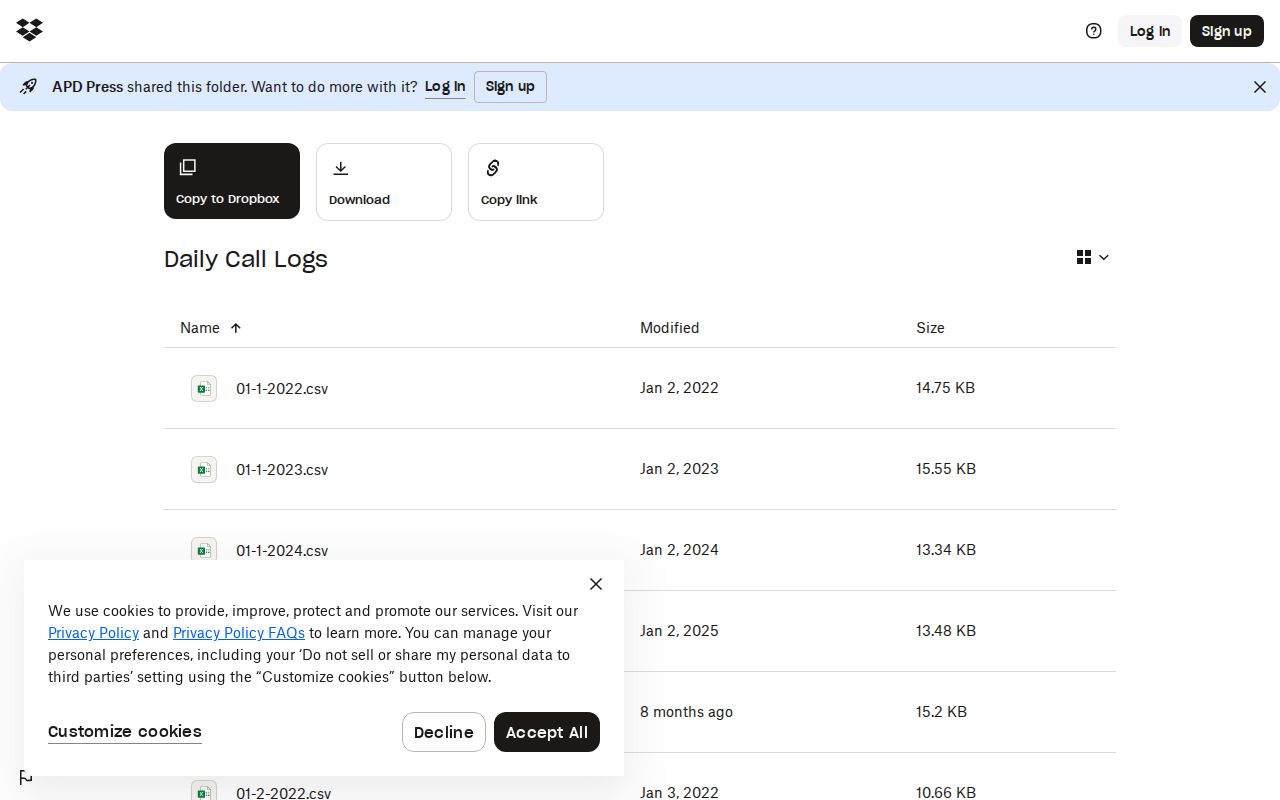
Treat these files as police logs. They are not a Madison County jail roster. A media log captures the street side of things: a complaint, the response, a time, a place, and which agency handled it. A jail record tells a different story, tracking custody, charges, bond, release, and booking identifiers. The two often overlap. Yet one arrest can appear in a log with no booking behind it, and a booking can stem from a warrant that the city log never mentions.
What Madison Log Records Mean
Each Madison County source carries different fields, so compare records carefully rather than merging entries that answer different questions.
| Source | Best use | Main limit |
|---|---|---|
| MCITS Inmate Inquiry | Booking dates, custody, photo when shown, agency, charge, bond, docket clues | Not every arrest enters county jail or remains public |
| APD media log | Anderson police incident activity | Not verified as a booking-photo list |
| Sheriff blotter | Labeled county blotter endpoint | Password-protected; public content cannot be inspected |
| Records Division response | Defined records and date ranges | Requires a specific request; fees may apply |
| Indiana MyCase | Filed case and later disposition | Not a jail custody feed |
A booking charge is only the first account of an arrest. Prosecutors may reduce it, drop it, or file it differently. The final disposition belongs to the court, so tie each fact to its source and date.
Weekend Arrest Log Gaps
Madison County posts no special weekend or holiday schedule for arrest records. A multi-day range still helps. Transport, intake, photos, and data entry can push one arrest across several calendar days. A range also catches people whose custody status changed after a first search.
Do not read a roster snapshot as a weekend surge. Counts shift with filters, releases, and live updates. That number is not an arrest statistic. Searching Friday through Monday makes sense for a weekend review. Report only the records you actually see. Confirm anything weighty with the records custodian.
Indiana's Public Access Counselor handbook requires covered daily-log information to be created within 24 hours. That rule sets no online posting time. Nor does it turn incident records into jail bookings.
Madison Log Archives and Requests
Madison County keeps things loose on the back end. The sheriff posts no public policy on roster retention. Nothing spells out how long entries stay or when old ones roll off. MCITS can surface older arrest details. How far back you can reach depends on filters, custody status, and whatever rules the system enforces that day. A third-party site may show only 30 days of Madison County arrests. That cap is the publisher's choice, not the county's archive window.
Gaps call for a records request. A narrow Indiana APRA request to the Madison County Sheriff's Records Division works best. Give the date range, plus any names or agencies you know. Spell out the exact records you want. Ask for arrest and daily-log material apart from booking photos, bonds, and releases. The division takes calls at 765-646-9290. Faxes go to 765-646-9296, and email goes to sheriff_recordsdivision@madisoncounty.in.gov. It promises no set turnaround and lists no separate fee for booking photos.
Anderson incidents take a different door. Use the APD Records page and its APRA form instead. Court history lives in MyCase. State-prison custody sits in the IDOC locator rather than a county blotter.
News and Unofficial Arrest Logs
Official sources still come first. The Herald Bulletin local-news section is the strongest local reporting route for Madison County arrests. WRTV keeps a county news page too. Neither runs on a fixed schedule, and neither posts a stable mugshot gallery. Editors pick which arrests become stories, so news can never replace a roster or a records response.
Aggregators are another matter. Sites like RecentlyBooked, Busted Newspaper, Arrests.org, Mugshots.com, and Mugshots.zone all carry Madison County sections. Their depth, update habits, and correction practices have no link to the county itself. Entries can sit stale, repeat, or miss later court outcomes. Treat them as leads rather than records.
News reports can add useful color around a Madison County arrest, so treat them as background only. The unofficial RecentlyBooked county page shows one publisher's rolling window of recent bookings.
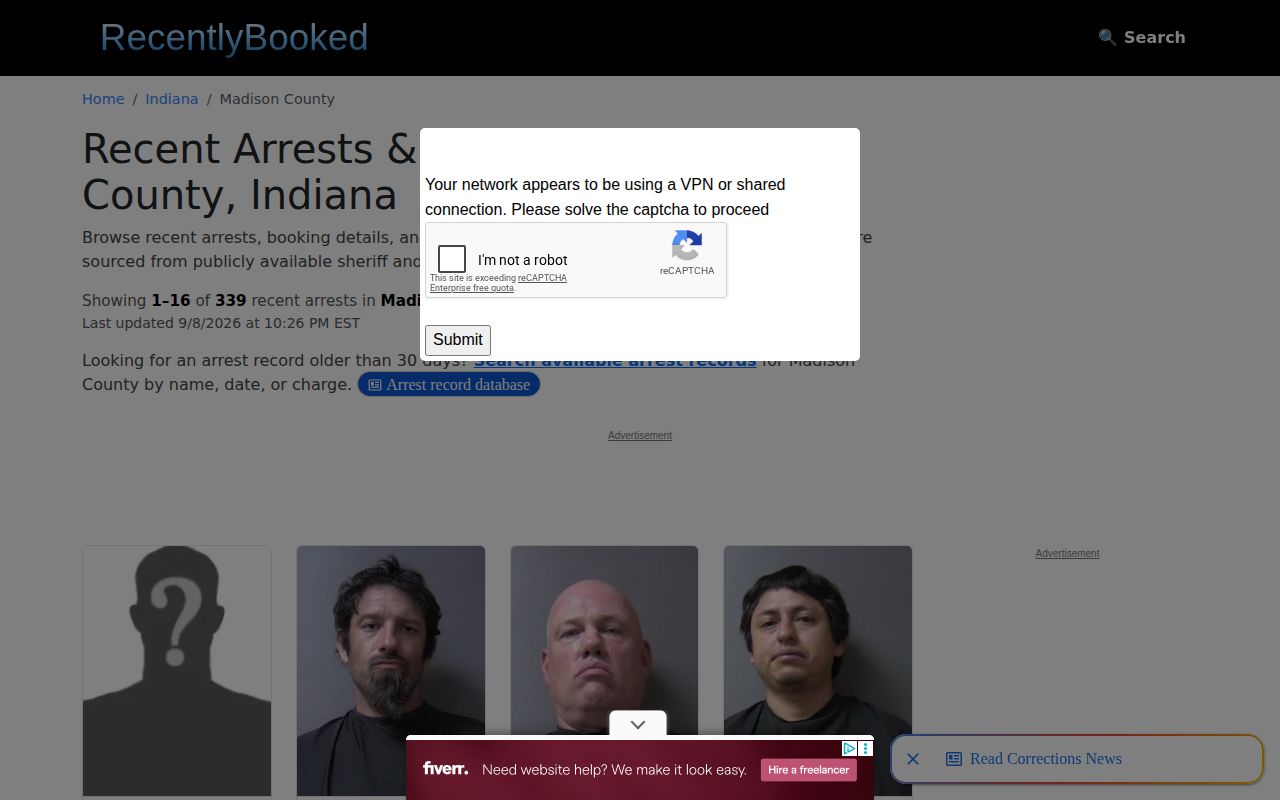
Its labels say nothing about how long the sheriff keeps a booking record or whether a person is still in custody.
From Booking to Court Disposition
One arrest can pass through several distinct stages. MCITS covers the jail side. It lists a booking date, a preliminary charge, bond, the arresting agency, and a cause number. MyCase picks up the court side later, with the filing, hearings, case status, and disposition. Check dates before you treat the two portals as one story. A booking date, for instance, is not always the moment of arrest. The charge on a jail record may not match what a prosecutor files.
Search by exact cause number whenever you have one. Otherwise use a party name. Then filter the MyCase results by court, status, case type, and filing date. Someone released from jail may still have an open court case. Someone still held may be controlled by a warrant, detainer, or separate case. Credit each detail to its reporting source.
Madison Custody Paths Over Time
Custody in Madison County rarely stays still. A name on the county roster today can vanish after a release or transfer. The booking record itself survives, though. The records custodian can still produce it. A state sentence shifts the active search to IDOC. Federal holds and immigration holds sit in their own locators. None of these later systems changes that. A police incident log will never amount to a full arrest history.
When dates matter, write down where and when you saw each fact. Ask the sheriff for receipt, discharge, or transfer details within your defined range. Then compare the answer with the court docket. Do not assume that a release closed the case.
Request a Defined Madison Date Range
A public-record request gets the best results when it asks for records that already exist. Do not ask for a custom summary. State the first and last dates of the range. Add the agency if you know it. Names, subject numbers, and booking numbers all help narrow a Madison County search. Request each category separately. Ask for arrest or daily-log records, jail intake records, booking photographs, bond information, and discharge or transfer entries. That structure lets the custodian see exactly what the office holds.
The Sheriff's Records Division takes requests by email, fax, or in person. Bring its form and a copy of state identification. Cash, money orders, cashier's checks, and cards are accepted. Payment follows the office's rules. Cards carry a service charge. Personal checks, phone payments, and online payments are not accepted. No weekly-log fee or guaranteed turnaround is published. Ask for an estimate first.
If a record is withheld or redacted, ask for the legal basis. Indiana APRA opens existing public records to inspection and copying, subject to lawful exceptions. It does not force an agency to build a new weekly report. The Indiana Public Access Counselor can clarify access law when a response stays murky.
Keep a dated copy of every request and response. If the public interface changes later, your own file preserves the trail.